
How AI is Democratizing Healthcare: From Rural to Global Cities

At Fit2Fortune, we strive to bring you the latest insights into health, wellness, and medical technology. Today, we are diving deep into a major revolution: AI in Healthcare
In today’s rapidly evolving world, technology is no longer just a luxury; it is becoming the backbone of a healthcare revolution. Specifically, AI in Healthcare is driving a massive shift in how we detect and treat diseases at the grassroots level. In this article, we explore how AI and wearable devices for health monitoring are bridging the gap from remote rural areas to major global cities, making diagnostics faster and more accurate than ever before. The future of medicine is no longer confined to hospital walls—it’s right there in the palm of your hand
Table of Contents
How AI in Healthcare is Transforming Point-of-Care Testing (POCT)
The integration of AI in Healthcare has triggered a massive shift in how medical tests are performed. Traditionally, Point-of-Care Testing (POCT) was limited by accuracy issues and slow manual processes. However, AI technologies like Machine Learning and Deep Learning are now solving these challenges by:
Enhancing Diagnostic Accuracy: AI algorithms can analyze complex medical data instantly, reducing human error and providing more reliable results at the bedside.
Improving Workflow Efficiency: Predictive analytics are being used to reduce device downtime by 20%, ensuring that medical tools are always ready for use in resource-limited settings.
Smarter Decision Making: AI-driven support systems are now helping doctors synthesize real-time data, which has already shown a 40% reduction in antibiotic misuse.
By moving diagnostics from massive laboratories to portable, AI-enhanced devices, we are making healthcare more proactive and patient-centered.
AI in Rural Healthcare: Breaking Geographical Barriers
One of the most significant achievements of AI in Healthcare is its ability to reach underserved populations where medical resources are scarce. In many rural areas, patients often have to wait weeks for simple diagnostic results. AI is changing this narrative by bringing “the lab to the patient.
Key highlights from recent implementations include:
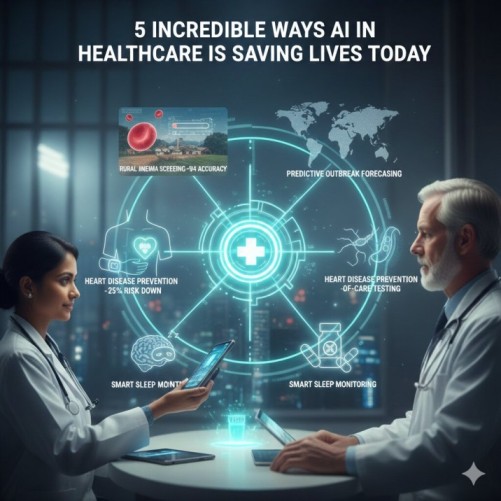
94% Accuracy in Anemia Screening: Portable AI devices are now being used in rural India to screen for anemia. These devices have demonstrated a staggering 94% accuracy, slashing diagnostic delays from several weeks to just a few hours.
Early Detection of Infectious Diseases: AI is not just for chronic conditions; it is also a hero in infectious disease management. For instance, AI models have shown up to 95% sensitivity in detecting malaria in regions like sub-Saharan Africa
Wearable AI and Remote Patient Monitoring
Beyond clinical settings, AI in Healthcare has made its way into our daily lives through sophisticated wearables. These are no longer just step-counters; they are powerful diagnostic tools. By utilizing AI and wearable devices for health monitoring, we can now achieve:
Heart Health Optimization: AI algorithms integrated with wearable data can tailor therapies and monitor vitals in real-time, which has the potential to reduce cardiovascular events by up to 25%.
Sleep Disorder Detection: Recent meta-analysis shows that wearable AI can differentiate between types of apnea (like obstructive vs. central sleep apnea) with over 81% accuracy, helping patients get treated before complications arise.
Continuous Care: Instead of a once-a-year checkup, these devices offer 24/7 monitoring, providing a safety net for elderly patients or those with chronic conditions.
Overcoming Challenges: Data Privacy and Ethical AI
While the potential of AI in Healthcare is immense, its implementation is not without significant hurdles. To truly democratize healthcare, we must address the ethical and technical challenges that come with machine-learning models.
Data Privacy and Security: Since AI systems require massive amounts of patient data to learn, protecting sensitive medical records is a top priority. Ensuring compliance with global standards like GDPR or local health data laws is essential to prevent data breaches.
Algorithmic Bias: If an AI model is trained only on data from urban populations, it might not perform accurately for patients in rural India. Addressing this “bias” is crucial for ensuring that AI in Healthcare remains equitable for everyone, regardless of their ethnicity or geography.
The Need for Human Oversight: AI is a tool to assist doctors, not replace them. Maintaining a “Human-in-the-loop” approach ensures that final medical decisions are always vetted by a qualified professional, especially in critical life-and-death situations.
Interoperability: For AI and wearable devices for health monitoring to work effectively, different systems must be able to talk to each other. Standardizing data formats across various hospitals and devices remains a work in progress in 2026.
Conclusion: The Future of Universal Healthcare
The integration of AI in Healthcare is more than just a technological trend; it is a fundamental shift toward making quality medical care accessible to everyone. From a small clinic in rural India area to the most advanced hospitals in global cities, AI is bridging the gap by providing affordable, accurate, and timely diagnostics. While challenges like data privacy and ethical implementation remain, the progress we see in 2026 is promising. By embracing AI and wearable devices for health monitoring, we are moving toward a world where healthcare is proactive, personalized, and truly democratized.
What Do You Think ?
We are witnessing a new era of medicine, but technology is only half the story.
Do you believe AI can eventually replace traditional lab tests entirely? * Are you currently using any AI-powered wearable to track your health?
Share your thoughts and experiences in the comments below! If you found this article insightful, don’t forget to share it with your network to spread awareness about the future of healthcare.
Frequently Asked Questions (FAQ)
References & Further Reading
To ensure the highest level of accuracy, the data and case studies mentioned in this article are based on recent scientific literature and systematic reviews:
- PubMed Research: This article draws key insights from the systematic review on the Transformation of Point-of-Care Testing through AI . View Research on PubMed
Medical Disclaimer
Disclaimer: The information provided in this article, including data from recent studies and AI trends, is for informational and educational purposes only. It is not intended to be a substitute for professional medical advice, diagnosis, or treatment. Always seek the advice of your physician or other qualified health provider with any questions you may have regarding a medical condition. Never disregard professional medical advice or delay in seeking it because of something you have read on this website. The AI tools and wearable devices mentioned are supportive technologies and should be used under the supervision of certified medical professionals.