
Written by Paresh Shah, Pharmacist | Last updated: October 5, 2026
Knee Pain Exercises at Home: Gentle Moves to Support Stronger Knees
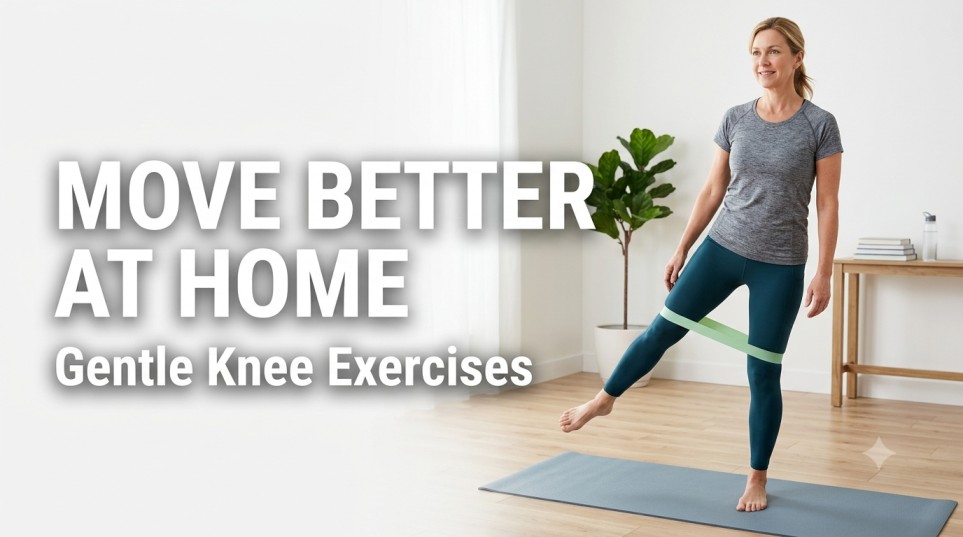
Knee pain exercises at home may help improve strength, mobility, and daily function when the exercises are appropriate for the underlying problem. Gentle, controlled movement can be useful for some people with joint pain, including those with arthritis, but the right exercises and intensity depend on your symptoms and physical ability.
A painful knee can make simple activities such as walking, climbing stairs, standing up, or getting out of a chair feel harder than usual. It is tempting to avoid movement completely, but staying active within your ability can be an important part of managing many types of knee problems. The goal is not to push through pain—it is to use controlled movements that support the muscles and mobility around the knee.
Because knee pain has many possible causes, these exercises should not be treated as a one-size-fits-all treatment. Pain following a significant injury, inability to bear weight, major swelling or deformity, or a hot and red knee with fever requires medical attention rather than simply starting a home exercise routine..
This guide focuses on gentle knee exercises at home that can be adapted for beginners and people who want a simple routine without gym equipment. It will also explain how to approach knee strengthening exercises for beginners, what discomfort may be a reason to modify an exercise, and when knee pain should be evaluated by a healthcare professional.
Who Should Be Careful Before Exercising With Knee Pain?
Not every type of knee pain is appropriate for a home exercise routine. Before starting knee pain exercises at home, consider how the pain began, whether the knee is swollen or unstable, and whether you can comfortably put weight on the leg.
When gentle exercise may be reasonable
For mild or ongoing knee discomfort that does not appear to be related to a serious injury, gentle movement and strengthening may help maintain mobility and support the muscles around the joint. Starting slowly and increasing activity gradually is generally more appropriate than immediately doing high-impact exercises.
For people looking for knee exercises for beginners with pain, low-impact movements that can be performed with controlled range of motion are often easier to modify than jumping, running, or deep squats.
When to stop and seek medical advice
Exercise should not be used to push through significant or worsening pain. Stop an exercise and consider professional evaluation if you develop severe pain, substantial swelling, a feeling that the knee is giving way, difficulty bearing weight, or symptoms that began after a significant injury.
A knee that becomes hot and red, particularly when accompanied by fever or feeling unwell, also warrants prompt medical attention because some causes of knee pain require medical treatment rather than home exercise. (NHS)
The aim of knee strengthening workouts at home is to gradually support movement and strength—not to prove that you can tolerate more pain. Gentle exercises for knee pain should feel controlled and manageable, and the routine should be adjusted when your symptoms do not respond well.
How to Start Knee Exercises Safely at Home
Before doing knee pain exercises at home, start with a level of movement that feels manageable rather than trying to complete a demanding routine on the first day. For people with joint problems, the CDC recommends starting slowly and increasing activity in small amounts as the body becomes accustomed to it.
A simple approach is to begin with gentle movements that work on knee mobility and leg strength without placing unnecessary stress on the joint. Exercises can be performed using your body weight or simple household support, depending on your balance and comfort.
A few basic guidelines
Keep your movements slow and controlled, and avoid bouncing or forcing the knee into a position that causes significant discomfort. If an exercise consistently makes your symptoms worse, reduce the range of motion, lower the intensity, or choose a different movement.
You do not need a long workout to get started. Short periods of activity can be useful, and strength, flexibility, and low-impact aerobic activity can all have a place in a joint-friendly exercise routine.
The exercises below focus on practical movements that can be done at home and adapted for different ability levels. If you have a known knee condition, a recent injury, or significant symptoms, a healthcare professional or physical therapist can help determine which movements are appropriate for you.
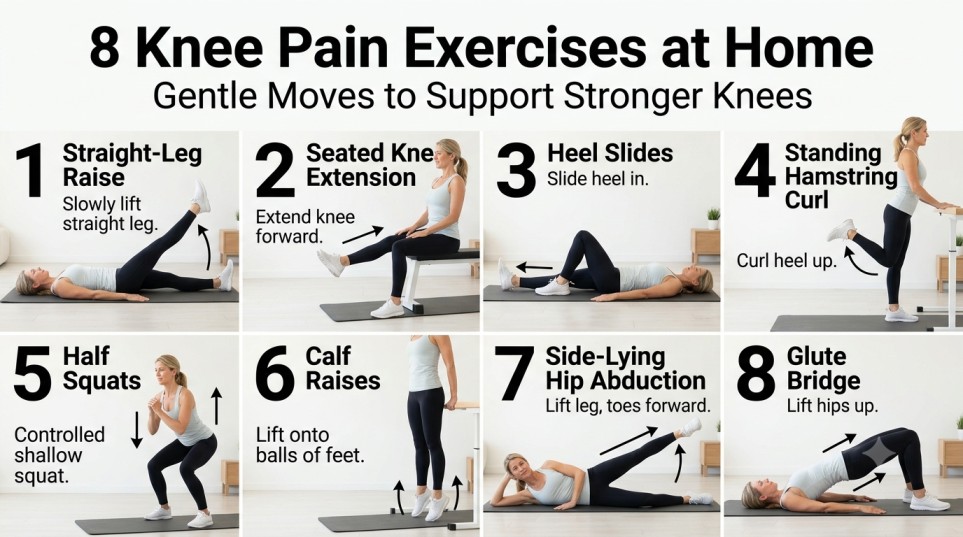
1. Straight-Leg Raise
The straight-leg raise is a simple knee strengthening exercise for beginners that targets the quadriceps, the muscles at the front of the thigh. Strengthening the muscles around the knee can help support everyday movements such as walking and getting up from a chair.
How to do it
- Lie on your back with both legs straight.
- Bend one knee so that the foot rests comfortably on the floor.
- Keep the other leg straight and tighten the thigh muscle.
- Slowly lift the straight leg several inches off the floor.
- Hold briefly, then lower the leg in a controlled movement.
- Repeat on the other side if appropriate.
Avoid swinging the leg or lifting it higher than you can control comfortably. AAOS describes this exercise with a brief hold and controlled lowering rather than a fast movement.
A reasonable starting point is about 5–10 repetitions, depending on your current strength and comfort. You can gradually increase repetitions as the movement becomes easier rather than immediately adding resistance.
Stop or modify the exercise if it causes significant or worsening knee pain. People recovering from an injury or with a known knee condition should follow the guidance of their healthcare professional or physical therapist.
2. Seated Knee Extension
The seated knee extension is a simple knee strengthening exercise at home that targets the quadriceps at the front of the thigh. Because you perform it from a chair, it can be easier to control than weight-bearing exercises such as squats. (AAOS)
How to do it
- Sit upright on a sturdy chair with your feet flat on the floor.
- Keep one thigh supported by the chair.
- Slowly straighten one knee and raise your foot forward.
- Tighten the muscles at the front of your thigh as the leg straightens.
- Pause briefly, then slowly lower your foot back to the floor.
- Repeat with the other leg if comfortable.
Keep the movement controlled and avoid swinging the lower leg or using momentum. AAOS specifically recommends avoiding forceful momentum when performing this exercise. (AAOS)
A beginner can start with around 5–10 repetitions per leg, using a comfortable range of motion. NHS guidance for seated knee extension commonly uses controlled repetitions with a brief hold, but the appropriate amount can vary depending on the individual and the reason for the knee pain. (Leeds Teaching Hospitals NHS Trust)
The exercise should remain controlled and manageable. Reduce the range of motion or stop if it causes significant or increasing pain.
3. Heel Slides
Heel slides are a gentle knee mobility exercise at home that can help you practice bending and straightening the knee through a comfortable range of motion. NHS physiotherapy guidance includes heel slides among early knee exercises and recommends performing the movement gradually rather than forcing the knee into a deeper bend.
How to do it
- Lie on your back with both legs extended comfortably.
- Slowly slide one heel toward your buttocks, allowing the knee to bend.
- Move the heel only as far as feels comfortable.
- Pause briefly, then slowly slide the heel back until the leg is straight.
- Repeat with the other leg if appropriate.
Keep the movement smooth and controlled. You do not need to force your knee to bend as far as possible. The aim is to work on comfortable movement rather than pushing through significant pain.
Start with about 5–10 repetitions per side, then gradually increase the amount if the movement remains comfortable. Some NHS exercise programs use higher repetition ranges, but the appropriate amount can vary depending on why your knee hurts and your current mobility.
If the exercise causes significant pain or noticeably worsens your symptoms, stop and seek advice from a healthcare professional, particularly if you are recovering from an injury or surgery.
4. Standing Hamstring Curl
The standing hamstring curl works the muscles at the back of your thigh and can be a useful addition to a gentle knee strengthening routine at home. The American Academy of Orthopaedic Surgeons includes hamstring curls in its knee conditioning program and recommends using a chair or wall for balance when needed. (AAOS)
How to do it
- Stand upright behind a sturdy chair or next to a wall for support.
- Keep your thighs relatively close together and your supporting leg slightly relaxed.
- Slowly bend one knee, bringing your heel toward the back of your thigh.
- Lift the heel only as far as you can comfortably control.
- Pause briefly, then slowly lower the foot back to the floor.
- Repeat on the other side.
Keep your upper body upright and avoid swinging the leg backward. The movement should come primarily from bending the knee rather than from moving your entire hip.
For beginners, 5–10 controlled repetitions per leg can be a reasonable starting point. As the exercise becomes easier and remains comfortable, you can gradually increase the repetitions or follow a more individualized program from a physical therapist.
AAOS describes a higher-volume routine for its knee conditioning program, but that does not mean the same number is appropriate for everyone with knee pain. Your repetitions should match your current strength, symptoms, and reason for doing the exercise. (AAOS)
5. Half Squats
Half squats are a functional knee strengthening exercise at home that work the quadriceps, hamstrings, and gluteal muscles. Because you only lower partway into the squat, the movement can be easier to control than a deep squat. The American Academy of Orthopaedic Surgeons (AAOS) includes half squats in its knee conditioning program.
How to do it
- Stand with your feet about shoulder-width apart.
- Keep your chest lifted and your back in a comfortable neutral position.
- Hold the back of a sturdy chair or use a wall for balance if needed.
- Slowly lower your hips as though you are beginning to sit in a chair.
- Lower only as far as you can comfortably control.
- Pause briefly, then press through your feet to return to standing.
Avoid dropping quickly into the squat or allowing your knees to collapse inward. AAOS recommends keeping the movement controlled and lowering only partway rather than performing a deep squat.
Beginners can start with 5–8 repetitions and focus on comfortable technique. As your strength improves, you can gradually increase the number of repetitions.
You do not need to match the higher repetition volume used in a formal AAOS conditioning program. The appropriate amount depends on your current strength, symptoms, and the reason for your knee pain.
If the exercise causes significant pain, stop and modify the movement or seek guidance from a healthcare professional.
6. Calf Raises
Calf raises are a simple knee-friendly exercise at home that strengthens the calf muscles and can complement exercises that target the thigh and hip. The American Academy of Orthopaedic Surgeons (AAOS) includes calf raises in its knee conditioning program and recommends using a chair or wall for balance.
How to do it
- Stand upright behind a sturdy chair or near a wall.
- Keep both feet about hip-width apart and place your weight evenly through your feet.
- Slowly raise your heels so that you come up onto the balls of your feet.
- Pause briefly at the top of the movement.
- Slowly lower your heels back to the floor.
- Keep your body upright and avoid bouncing.
For beginners, performing the exercise with both legs at the same time can make it easier to control. As strength and balance improve, a healthcare professional or physical therapist may recommend a more challenging variation.
Start with 8–10 controlled repetitions and focus on steady movement rather than speed. AAOS lists 2 sets of 10 repetitions in its knee conditioning program, but the right amount for you may differ depending on your symptoms, strength, and overall condition.
Stop the exercise if it causes significant knee pain, sharp pain, or worsening symptoms. Use the chair or wall for stability rather than trying to balance without support.
7. Side-Lying Hip Abduction
Side-lying hip abduction strengthens the muscles along the outer hip and buttock. These muscles help support lower-body movement, making this a useful addition to a broader knee strengthening routine at home. The American Academy of Orthopaedic Surgeons (AAOS) includes hip abduction in its knee conditioning program.
How to do it
- Lie on your side with the leg you want to exercise on top.
- Keep the bottom leg slightly bent for support.
- Straighten the top leg without locking the knee.
- Slowly raise the top leg upward while keeping your toes pointing forward.
- Pause briefly, then lower the leg in a controlled movement.
- Keep your hips stacked rather than rolling backward as you lift.
AAOS recommends avoiding rotation of the leg while raising it. The movement should come from the hip rather than from twisting the leg or body.
Start with 8–10 controlled repetitions per side if you are new to the exercise. Focus on proper form rather than trying to lift the leg as high as possible. A formal AAOS conditioning program uses a higher repetition target, but the appropriate amount can vary according to your strength and symptoms.
Stop or modify the exercise if it causes significant pain or makes your knee symptoms worse. If you have an existing knee injury or medical condition, a physical therapist can help determine whether this movement is appropriate for you.
8. Glute Bridge
The glute bridge strengthens the muscles of the buttocks and the back of the hips, which play an important role in lower-body movement. It can be a useful addition to a knee strengthening routine at home because it works the hips without requiring repeated bending of the knee under body weight. NHS physiotherapy guidance includes the bridge among beginner knee exercises.
How to do it
- Lie on your back with your knees bent and your feet flat on the floor.
- Keep your feet about hip-width apart.
- Gently tighten your abdominal and buttock muscles.
- Slowly lift your hips off the floor while keeping your shoulders and upper back down.
- Pause briefly at the top without excessively arching your lower back.
- Slowly lower your hips back to the starting position.
Keep the movement controlled and focus on squeezing your glute muscles rather than trying to lift your hips as high as possible.
Start with 8–10 repetitions and use a comfortable range of motion. As the exercise becomes easier, you can gradually increase the repetitions or ask a physical therapist about progressing the movement.
The exact number is not the same for everyone with knee pain. Your routine should depend on your symptoms, strength, and the underlying reason for your knee discomfort.
How Often Should You Do Knee Exercises?
Doing knee pain exercises at home consistently is generally more useful than trying to complete a difficult workout occasionally. Your ideal frequency depends on your current fitness level, the cause of your knee pain, and how your body responds to exercise.
For beginners, starting with a manageable routine 2–3 days per week can be a practical approach. On other days, gentle walking or other low-impact activity may provide additional movement without turning every day into a strength-training session. The CDC recommends gradually increasing physical activity rather than doing too much too quickly. (CDC)
How to progress gradually
When an exercise starts feeling easier and does not increase your symptoms, progress one variable at a time. You might add a few repetitions, increase the number of sets, or gradually make the movement more challenging.
There is no need to increase everything at once. A slower progression can make it easier to identify whether a change in your routine is aggravating your knee.
👉 If stiffness is also a concern, these ways to prevent joint stiffness after 40 may provide additional daily strategies to support mobility.
What if your knee feels sore afterward?
Some people may experience mild muscle soreness when beginning a new strengthening routine. However, significant or worsening joint pain is different. If your knee becomes noticeably more painful, swollen, or difficult to use after exercise, reduce the intensity or stop the exercise and consider discussing the symptoms with a healthcare professional.
The goal of a beginner knee exercise routine is to build strength and movement gradually while keeping the activity manageable—not to exercise through significant pain.
A Simple Weekly Knee Exercise Routine
Once you know the exercises, the next step is creating a routine that is realistic enough to follow consistently. There is no need to perform every movement at full volume every day. A gradual approach can make it easier to build strength while monitoring how your knee responds.
The AAOS Knee Conditioning Program recommends knee-strengthening work on 2 to 3 days per week in its general guidance, while the CDC recommends muscle-strengthening activity on at least 2 days per week for adults. (AAOS, CDC)
Example weekly schedule
| Day | Suggested activity |
|---|---|
| Monday | Knee-strengthening routine |
| Tuesday | Gentle walking or another comfortable low-impact activity |
| Wednesday | Rest or light mobility work |
| Thursday | Knee-strengthening routine |
| Friday | Gentle activity at a comfortable pace |
| Saturday | Optional light mobility or walking |
| Sunday | Rest |
This schedule is only an example. People with different causes or levels of knee pain may need a different plan, and someone recovering from an injury or surgery should follow the advice of their healthcare professional or physical therapist.
The CDC also notes that physical activity can be divided into shorter sessions, so you do not have to complete everything in one long workout. Start with what you can manage and increase activity gradually as your body becomes accustomed to it.
The key is consistency. A manageable weekly knee exercise routine is more practical than an intense schedule that repeatedly aggravates your symptoms.
Key Takeaways for Exercising With Knee Pain
A simple routine can be easier to follow when you focus on a few basic principles rather than trying to do every exercise perfectly.
- Start with movements you can perform with controlled, comfortable form.
- Begin with a manageable number of repetitions and increase gradually as your strength improves.
- Include a combination of mobility, leg strengthening, and hip or glute exercises rather than focusing on only one muscle group.
- Use low-impact activities such as walking, cycling, or swimming on appropriate days to stay active without relying entirely on strength exercises. (CDC)
- Do not treat significant or worsening pain as something you simply need to push through.
- Stop and seek medical advice when symptoms are severe, the knee becomes badly swollen or changes shape, you cannot bear weight, or you develop a hot, red, swollen knee with fever. (NHS)
Most importantly, gentle knee pain exercises at home should be adapted to your individual symptoms and ability. A routine that is appropriate for one person may not be appropriate for someone with a different knee condition or a recent injury.
When pain persists or interferes with everyday activities, a healthcare professional or physical therapist can help identify the likely cause and develop a more appropriate exercise plan.
Frequently Asked Questions
At-home knee joint exercises is only one part of supporting long-term joint health. Nutrition and everyday eating habits can also play a role in an overall healthy lifestyle. Learn more about foods for healthy joints.
Conclusion
Knee pain does not always mean you need to avoid movement. For many people, a gradual combination of mobility work, strengthening exercises, and low-impact activity can support better movement and everyday function.
The exercises in this guide are intended as general information, not as a personalized treatment plan. Start at a level you can control comfortably, progress gradually, and pay attention to how your knee responds. Avoid pushing through significant or worsening pain.
Because knee pain can have many different causes, persistent symptoms, significant swelling, difficulty bearing weight, or pain following an injury should be evaluated by a qualified healthcare professional.
With the right approach, knee pain exercises at home can be part of a practical routine for maintaining strength and mobility while you work toward staying active safely.
Medical Disclaimer: This article is for educational purposes only and does not replace professional medical advice, diagnosis, or treatment. Always consult a qualified healthcare professional before starting a new exercise program, particularly if you have an existing medical condition, recent injury, or persistent knee pain.